Paleo Art - Dinosaurs
A selection of my paleo art, concerned with dinosaurs and often in the context of their extinction.
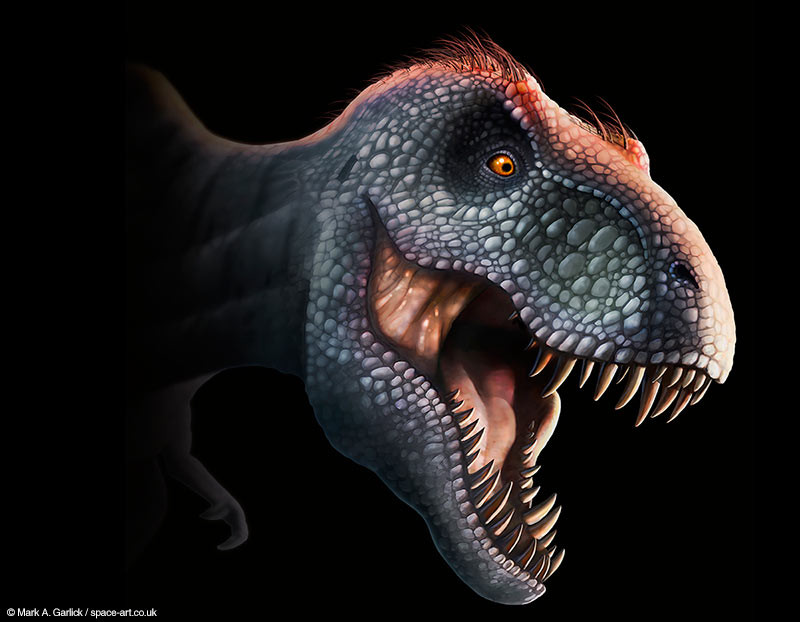
T Rex Head Study. Photoshop.

Triceratops Herd. Photoshop and Daz.

Confrontation - a duel between a tyrannosaurus and triceratops. Photoshop and Daz.

New Life. Client Science et Vie Junior. Photoshop and Vue.

End of Days. Photoshop and Vue.

Fire in the Sky. Client Science et Vie Junior. Photoshop and Vue.

Spinosaurus. Photoshop, Daz and Vue.

Cretaceous Showdown. Photoshop and Terragen.

Deadly Impact. Photoshop and Vue.

Exodus. Photoshop.

End of Days III. Photoshop and Vue.

Scavenger. Artwork of T-rex. Done in Photoshop and 3DS Max.

Forest Flight. Artwork of pteranodon. Done in Photoshop.

Spinosaurus Head Study. Daz and Photoshop.

Compsognathus. Photoshop and photography composite.
A video explaining the extinction of the dinosaurs.

The Rise of Mammals. Photoshop.

Archaeopteryx. Done in Photoshop and Vue.

End of Days II. Photoshop and 3DS .

Illustration of a pair of suchomimus dinosaurs. This bipedal spinosaurid dinosaur is known from fossils discovered in the Sahara in 1998. The fossils date from the middle part of the Cretaceous period, 110 to 120 million years ago. This dinosaur, around 1

Parasaurolophus ('near-crested lizard'), first described in 1922, was a dinosaur that lived at the end of the Cretaceous period, around 70 million years ago, in what is now North America. It was a hadrosaurid dinosaur, a diverse family of plant-eating ani

Illustration of a Kentosaurus dinosaur. Kentrosaurus was an akylosaurid - the same group to which its more famous cousin stegosaurus belongs. Kentrosaurus was smaller, however, at 5 meters long, 2 meters tall, and with a weight of about a tone. Kentrosaur

Spinosaurus (meaning 'spine lizard') was arguably the largest known meat-eating dinosaur. It was longer even than Tyrannosaurus and Giganotosaurus at, according to one estimate, up to 18m in length. Named for the elongated spinal bones that make up the cu

Spinosaurus (meaning 'spine lizard') was arguably the largest known meat-eating dinosaur at, according to one estimate, up to 18m in length. Named for the elongated spinal bones that make up the curious sail on its back, spinosaurus was probably a fish-ea

Artwork of the Cretaceous dinosaur dineobellator, whose remains have been found in North America. This animal was around 2.5 to 3 metres in length, weighed up to 40 kg, and there is evidence that is had feathers. It belongs to a groupd of dinosaurs calle

Titans. Artwork of a herd of titanosaurs in the Cretaceous period.